Capture of Johanna Leonberger by the Kiowa
News of the WorldThe Capture of Johanna Leonberger by the Kiowa is the rupture that shaped Johanna’s childhood and made her eventual return to her German relatives a second displacement rather than a straightforward homecoming. Taken at about six in a raid near Castroville, Texas, she lost her parents and little sister, then spent four years growing up among the Kiowa. The novel presents the capture not only as an act of violence, but as the beginning of a lived kinship whose claims survive the effort to return her.
The Raid and Its Aftermath
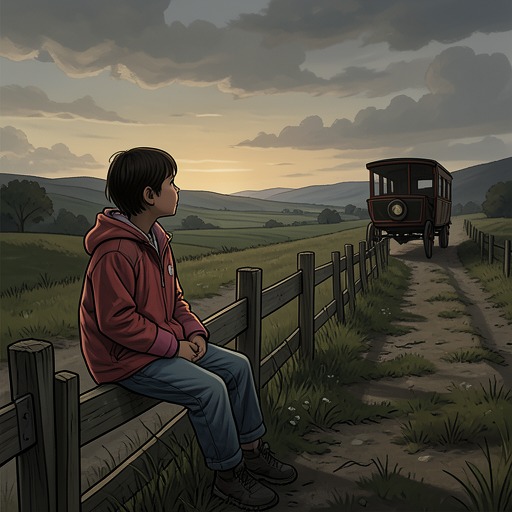
At the time Britt Johnson explains her history to Jefferson Kyle Kidd, Johanna is about ten. She had been captured four years earlier near Castroville, south of San Antonio, Texas. Her parents and younger sister were killed in the raid. The surviving account gives no detailed reconstruction of the attack itself; instead, it makes the loss plain through the facts that shape her present: a child taken from her family, and no surviving parent to receive her back.
The Kiowa did not merely hold Johanna as a prisoner. She became attached to a Kiowa family and learned its language and ways. When the Kiowa eventually brought her in, her Kiowa mother cut her arms and cried so loudly that, Britt says, the sound carried for a mile. The separation thus repeated the original loss in altered form: the child was being taken from one family after already losing another.
Surrender and Transfer
Johanna’s removal followed pressure from the Indian Agent. Britt reports that the Kiowa had learned that keeping a white captive brought cavalry pursuit; the Agent threatened to cut off their rations and send the Twelfth and Ninth after them unless they brought in the captives. The band that brought Johanna in received fifteen Hudson’s Bay four-stripe blankets and a set of German coin-silver dinnerware, which, Britt says, could be beaten into bracelets. The transfer was therefore shaped by both military coercion and exchange, not by any indication that Johanna had chosen to leave the people she knew as family.
The Agent identified her as Johanna Leonberger and had papers from her aunt and uncle, Wilhelm Leonberger and Anna Leonberger, asking for her return to Castroville. They sent a fifty-dollar gold piece to pay for her transport. Britt had already helped rescue captives from the Comanche, the Kiowa, and the Cheyenne, and had recovered his own wife and two children after their capture. Yet he was unwilling to carry Johanna all the way south: the journey would take three weeks each way, and he had no freight to haul on the return. His hesitation makes the distance between an official order to return a child and the difficult work of actually bringing her home concrete.
A Child Between Families
The novel shows the captivity’s continuing force in Johanna’s behavior and speech. Kiowa words remain alive in her mind even when she does not speak aloud. During a flood at the Red River, she sees a party of Kiowa across the water and calls to them, including for her mother; the river is too loud for them to hear. Her appeal is not simply a wish to escape a captor. She is reaching toward the family and life on the Plains that she remembers as her own.
Her acquired identity also appears in action. During a later fight with Caddo attackers, Johanna moves among the rocks barefoot, helps lever a slab of stone down upon a concealed man, and declares that the attackers will die. Afterward she raises a butcher knife and sings a Kiowa triumph chant. These moments present her as a child capable of judgment and initiative, while showing how fully the years after the capture have formed her. The capture’s consequences cannot be measured only by where she is physically taken: the Kiowa language, attachments, and habits have become part of her life.
Return Without Restoration
Britt eventually agrees to take Johanna out of Indian Territory and across the Red River, but the journey does not restore the childhood taken in the raid. Jefferson Kyle Kidd understands that she thinks of herself as Kiowa and will need a gradual adjustment; he knows she has already changed guardians three times. News of her return, however, travels faster than anyone can manage her transition. Her relatives are eager to see her, while she sits among their household objects as if the room itself were foreign. When asked to remember her German past, she struggles before saying that her mother and father are dead.
The relatives’ claim is also more fragile than blood ties alone suggest. A messenger tells Jefferson Kyle Kidd that the Leonbergers have no adoption papers for Johanna and may be unwilling to adopt her, since adoption would legally require support and, by custom, a dowry. Later, Jefferson finds her alone after dark, sent into an unfamiliar field with heavy halters and a bucket of corn to fetch horses. At ten, she is still wearing the same dress, and she calls softly to the horses in Kiowa. The scene measures the distance between being delivered to relatives and being securely cared for by them.
The book’s closing remembrance names her as Cicada, the little blue-eyed girl taken from the Kiowa by the Indian Agent and associated with Three Spotted. That name preserves the other side of the capture’s history: Johanna’s Kiowa life is not erased by her return to her German relatives. The event begins a forced separation, but its meaning remains contested among families, languages, and competing claims to who Johanna is.